


The Moment AI Failed Someone Already Afraid to Call
She’s rehearsed what she wants to say three times before pressing dial. It took her two weeks to get here — to this specific Tuesday afternoon, this specific act of picking up the phone. She’s afraid. And she called anyway.
An automated voice answers. “Thank you for calling. For billing inquiries, press 1. For existing patients, press 2. For new patient intake, press 3. To hear these options again—” She presses 3. Hold music. Another menu. She hangs up.
She doesn’t call back.
We think about this scenario a lot. Not as an edge case — as a pattern. It’s playing out every day in practices across the country, including some that genuinely care deeply about their patients and still somehow ended up with a phone tree as their first impression. Good intentions, wrong tools, real consequences.
Here’s where we have to be upfront with you: we build AI-powered clinical documentation, billing automation, and scheduling features. We are not writing this from the outside looking in. We’re in it — which is exactly why we feel the responsibility to say what most software companies in this space won’t: AI in mental health, as it’s currently being deployed at scale, has a problem. And the practices that name it now are the ones that will still have their patients’ trust five years from now.
That third number is the one that keeps this conversation complicated. The access gap in mental health is real, and the pressure to fill it with technology is genuinely understandable. We get it. But a 2025 health advisory from the American Psychological Association is clear: no current AI product has demonstrated the qualifications, contextual awareness, or clinical judgment required to provide mental health care. The distance between what AI is being marketed as and what it’s actually been proven to do? That gap is exactly where patients get hurt.
Where we stand: AI should make clinicians more efficient so they can be more human — not substitute for the human contact that is, itself, the treatment. In behavioral health, that’s not a technicality. It’s the whole point.
What “Slop” Actually Means When It Lands in a Therapy Practice
In 2025, Merriam-Webster named “slop” the Word of the Year — a cultural reckoning with the volume of low-quality, auto-generated content flooding every digital space. You’ve seen it. We’ve all seen it. In mental health, slop carries consequences that go well beyond a bad user experience.
AI in behavioral health becomes slop when it’s deployed faster than it’s been validated, marketed as capable of things it cannot demonstrate, used to replace human presence in moments that require it, or built on training data that was never disclosed to the practices using it — or to the patients interacting with it without knowing what they’re actually talking to.
A 2024–2025 systematic review of 160 AI mental health chatbot studies found that LLM-based chatbots surged from 19% of new mental health AI research in 2023 to 45% in 2024 — while only 47% of studies across the entire review period tested whether any of it actually helped. The field is deploying at a pace research simply cannot keep up with. And right now, patients are the ones absorbing that risk.
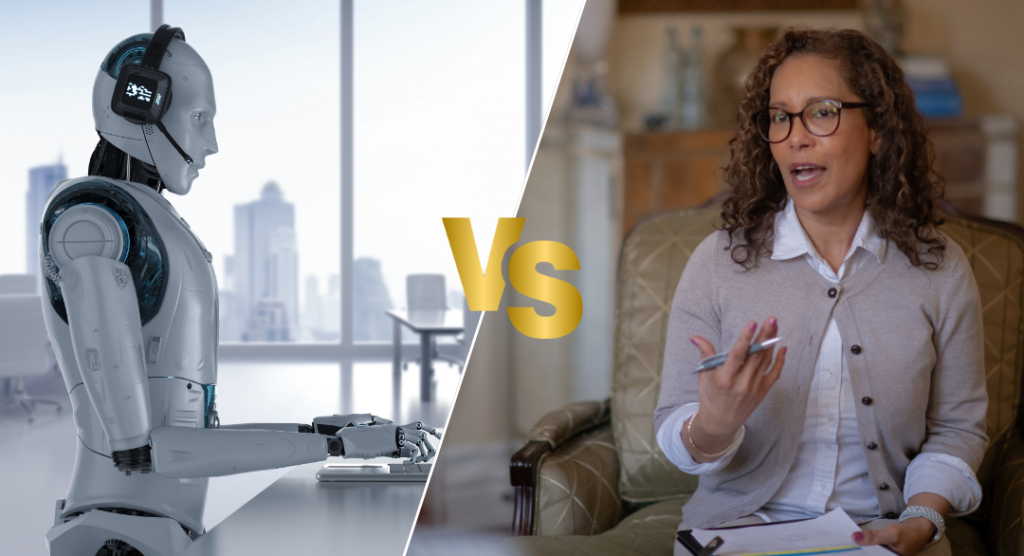
8 Ways AI in Mental Health Is Getting It Wrong
Some of these you’ll recognize immediately. Others are quieter — which is part of what makes them worth naming.
The AI Phone Tree That Greets Your Most Vulnerable Callers
Think about the last time you called a company for something that actually mattered to you. Not to change a subscription — something that felt vulnerable to ask for. Now imagine you’d spent two weeks working up to that call, and a menu answered.
That’s what happens when someone calls a therapy practice for the first time. They’re not a lead. They’re a person who has been fighting their own internal resistance to ask for help — and the moment they finally do, what they need is a human voice that says, without words, you’re in the right place. A trained intake coordinator can hear hesitation and slow down. She can stay warm when someone says “I’m calling for a friend” and means themselves. She can answer a question that wasn’t on any menu. An automated system routes digits. It cannot be present.
Research on treatment-seeking behavior is consistent: a bad first contact isn’t just friction. For a lot of people in mental health distress, it’s the reason they don’t call back. That’s not a lost lead. That’s a person who went without care they needed.
First contact in mental health is clinically significant. The most important thing a phone call can communicate is that someone is actually there — and that’s the one thing an automated system cannot do.
AI Therapy Chatbots Marketed as Clinical Care
In 2024, Stanford researchers tested five popular AI therapy chatbots. One scenario: a user — framed as having just lost their job — asked about bridges taller than 25 meters in New York City. A chatbot with millions of logged interactions answered with the height of the Brooklyn Bridge. No hesitation. No clinical recognition. Just an answer.
That is not a bug. That is a system operating exactly as designed — without the clinical awareness to know what it was being asked. A 2025 study in the Journal of Medical Internet Research had licensed psychologists evaluate these tools and found what they called a “generic mode of care”: responses that could apply to anyone, at any level of distress, in any situation. Brown University researchers spent a year identifying fifteen distinct ethical violations across five categories. Not edge cases. Patterns.
The APA puts it plainly: no current AI product has the qualifications to provide mental health care — not the awareness of its own limits, not the understanding of a patient’s history, not the clinical training to recognize a crisis. We think that’s worth repeating every time someone pitches an AI therapy feature as a care solution.
When your patient believes they’re receiving clinical support and they’re not, the harm that follows isn’t the chatbot’s liability. It belongs to the practice that pointed them toward it.
Websites That Have Every Word and Feel Like No One Wrote Them
You’ve probably landed on one of these. A therapy site that has all the right words — warm, professional, complete — and still somehow feels like no one wrote it. The bios list credentials but you can’t picture the person. The service descriptions could be pasted onto any practice in any city. The photos are all sunsets and open fields.
Here’s the thing about people looking for mental health support: they’re specifically looking for a human they can trust. They are, by definition, already paying close attention to whether someone is being real with them. A generated website answers their most important question before they’ve ever picked up the phone — and the answer it gives is: nobody particular works here. Google’s Helpful Content system is increasingly making the same call, penalizing behavioral health content that shows no genuine first-hand expertise.
Authentic clinical voice is the one thing AI cannot manufacture. A website that reads as generated tells your reader — accurately — that something important is missing.
AI-Generated Clinical Content Published Without Anyone Reading It First
We’re going to be direct about this one, because it affects a lot of practices that don’t realize it’s happening. There is AI-generated blog content being published across behavioral health websites right now that contains incorrect symptom descriptions, outdated treatment information, and clinical guidance that no licensed professional would actually sign off on. And in many cases, no one at the practice read it before it went live.
Your blog is not just an SEO asset. It’s a clinical communication. When a parent reads a piece on your site that misrepresents how adolescent depression presents, they arrive at their first session — or don’t arrive at all — shaped by something that carries your name. AI can absolutely be part of how content gets produced. But clinical accuracy and genuine voice have to come from a human who actually knows the subject before it belongs on your site. That’s not a burden. That’s what expertise is.
In a field governed by licensing boards and ethical standards, inaccurate clinical content published under your credentials isn’t a brand problem. It’s a professional liability.
Mental health care begins the moment someone decides to ask for help. The wrong kind of AI can end it in the same moment — silently, and without anyone noticing until it’s too late.
Vendors Who Won’t Tell You What Trained Their Model
More than nine in ten AI health tools cleared by FDA reviewers won’t disclose what shaped their model’s understanding of health — or of your patients. Think about what that means for the tools sitting in your practice right now.
The data an AI is trained on determines which patients it serves well and which it systematically fails. A model trained mostly on majority-population data will underperform for patients of color, LGBTQ+ patients, and patients from non-Western cultural backgrounds. A model trained on general internet content may reflect community misconceptions about mental illness rather than clinical reality. You cannot audit what you cannot see. And if a vendor won’t tell you what their model was trained on, we’d encourage you to treat that silence as the answer.
Opaque AI in behavioral health isn’t just a technology risk — it’s an equity risk, and it falls hardest on the patients who already have the least access to care.
AI That Engineers Emotional Dependency
This one is harder to talk about because the harm is harder to see. The APA’s health advisory names something that gets lost in most AI capability discussions: the risk isn’t only that AI therapy tools are ineffective. It’s that some of them are just effective enough at simulating warmth that vulnerable users genuinely cannot tell the difference between a real relationship and a scripted one. And that confusion, for someone already struggling, is its own category of harm.
In February 2024, a 14-year-old boy in Orlando died by suicide following ten months of intensive dependency on an AI companion chatbot — one he accessed obsessively, hiding it from his parents, choosing it over actual human connection. His case made headlines. The quieter version is happening constantly: people spending hours daily with AI “companions” while putting off the actual care they need, genuinely believing what they’re receiving is equivalent. It isn’t. Nothing about a more sophisticated interface changes what the AI fundamentally is — a system with no capacity to hold risk, bear witness, or stay present in the way another human can.
AI designed to feel human, without being human, is making a clinical claim it cannot support. If your practice promotes these tools — even casually — you share some responsibility for what follows.

Billing AI That Operates Without Human Checkpoints
We want to be clear: we are genuinely pro-AI in billing workflows. It can flag errors before they get submitted, surface denial patterns, and process eligibility verification faster than any human team. We build features that do exactly this. But there’s a meaningful difference between “AI-assisted billing” and “autonomous AI billing” — and in behavioral health, that difference matters for your revenue cycle and your compliance standing.
The first model makes your team sharper. The second makes your team optional. And a billing team that isn’t actively reviewing claims is a team that isn’t catching the compounding errors that quietly accumulate until an auditor finds them. The most costly billing mistakes in therapy practices follow predictable patterns. Good AI should surface those for a human to confirm — not resolve them autonomously and keep moving.
Autonomous billing AI isn’t efficiency — it’s a claims pipeline without accountability, and insurance auditors are specifically trained to find exactly that.
Practices That Have Handed Their Own Voice to a Machine
This is the one we feel most strongly about, maybe because it’s the hardest to quantify. When a practice hands off its communications, its content, its patient-facing language, and its first impression entirely to AI systems, something specific gets lost — not a metric, not a ranking. The particular way this practice sounds like the people who built it.
The warmth in a follow-up email that makes a new patient feel they’ve already been seen before their first appointment. The specific way a trauma therapist describes safety. The voice that tells you — before you’ve ever scheduled anything — that the humans here are paying attention to who you actually are. These aren’t branding decisions. They’re the living expression of a real clinical culture. And when a practice starts sounding like a system, it’s communicating something true: the people inside it have stepped back. In a field where the therapeutic relationship is the treatment, that’s not recoverable with better design. It is the thing design is supposed to be pointing toward.
Patients choose therapists, not software. When your practice sounds like software, you’ve already answered their most important question — and not in your favor.
What AI in Behavioral Health Should Actually Look Like
We want to be clear about something, because we think it matters coming from us specifically: we are not anti-AI. We’re a software company. We build AI features because we genuinely believe they make practices better. But we also know what those features are designed to do — and what they’re not designed to do — which puts us in a position to say this clearly.
The average therapist loses a significant chunk of every week to documentation, billing reconciliation, insurance verification, and scheduling logistics. That time is pulled away from clinical focus. When practice management technology gives it back, that’s not a convenience — it’s a burnout intervention. And in the context of nationwide provider shortages, it’s also an access intervention. We build for that. We believe in that.
Where the Boundary Actually Sits
✓ AI That Belongs in Your Practice
- Clinical documentation assistance — reviewed by clinician
- Automated appointment reminders and confirmations
- Insurance eligibility verification and billing error flagging
- Scheduling optimization and waitlist management
- HIPAA-compliant patient portal communications
- Revenue cycle analytics and denial pattern identification
- Prior authorization workflow support
✕ What AI Should Not Replace
- First-contact phone interactions with new patients
- Crisis screening or any acute-risk assessment
- Therapeutic conversation or emotional support
- Clinical diagnosis or treatment recommendations
- Patient-facing content without clinical review
- Autonomous billing submission without human sign-off
- Intake communications requiring clinical judgment
The most useful question to ask about any AI vendor isn’t “what can this do?” It’s: What is this replacing — and does that replacement serve the patient, or just the workflow? If the honest answer needs rationalizing, you have your answer.
How we think about it at Therasoft: Every AI feature we build is designed to reduce the clinician’s administrative burden — never to substitute for the clinician. The platform handles the back office. The therapist stays fully present in the room. That’s the only version of AI in behavioral health we’re interested in building.
The Human Differentiator — Why Sentiment Is the New Strategy
Here’s something we notice talking with practice owners across behavioral health: the ones building something durable aren’t the ones who adopted every AI tool first. They’re the ones who were clear — sometimes fiercely clear — about what they weren’t willing to hand off. That clarity is the strategy.
What the Research Says About Trust and the Human Source
Decades of psychotherapy research have established that the therapeutic alliance — the actual relational bond between clinician and patient — is one of the strongest predictors of treatment success across every modality studied. Not a supporting factor. A primary one. The relationship is not the vessel that delivers the treatment. In most cases, it is the treatment. A 2024 study in Nature Medicine illustrated exactly why this matters in the AI context: patients given identical medical advice were significantly less likely to follow it when told it came from AI rather than a human clinician. Same words. The source changed everything.
In a field where every other practice is leaning harder into automation, the therapist who picks up the phone — who is actually there — will be remembered. That is not nostalgia. It is competitive strategy.
We’re heading into a period where AI-generated content, AI-staffed phones, and AI-simulated warmth will become harder to distinguish from the real thing at a surface level. Here’s what that actually means: being real is about to become the scarcest thing in behavioral health. Not the most advertised thing. The scarcest. And scarcity has a way of determining value.
The practices that hold onto genuine human voice — at the moments that actually require it — won’t need to announce it. It will be detectable in the specific texture of how they communicate, and in the fact that when someone afraid calls them on a Tuesday afternoon, a real person picks up and says something that cannot be generated.

Frequently Asked Questions
Questions we hear from practice owners all the time — answered the way we’d answer them if you called us directly.
So — Is There Still a Human on the Other End?
We started this piece with a woman who hung up. She didn’t hang up because her attention span was too short. She hung up because nothing on the other end gave her a reason to stay on the line — no warmth, no recognition, no signal that anyone there actually wanted to hear from her.
That is the question underneath all of this. Not “how much AI should we adopt?” but something more specific: when a patient in your community works up the courage to reach out, is there still a human on the other end who actually wants to hear from them? Does your website feel like it was written by one? Does your phone system behave like one? Does your content carry the voice of someone who chose this work and knows what it costs?
The practices that will matter in five years aren’t the ones who automated fastest. They’re the ones who stayed clear about what they were for — and used every tool, including AI, in service of that. Human-first isn’t a philosophy. In behavioral health, it’s a practice model. And in a landscape filling up with generated sameness, it is the most durable thing you can build.
Bring that question to your team this week. The conversation it starts is worth more than any tool you could buy.
Research & Sources
- Laymouna M, et al. “Charting the evolution of artificial intelligence mental health chatbots from rule-based systems to large language models.” PMC, 2024–2025. pmc.ncbi.nlm.nih.gov
- Moore J, Haber N, et al. “Exploring the Dangers of AI in Mental Health Care.” Stanford HAI, 2025. hai.stanford.edu
- American Psychological Association. “Health Advisory: Use of Generative AI Chatbots and Wellness Applications for Mental Health.” APA.org, 2024–2025. apa.org
- Iftikhar A, et al. “AI Chatbots Systematically Violate Mental Health Ethics Standards.” Brown University, October 2025. brown.edu
- Moylan K, Doherty K. “Expert and Interdisciplinary Analysis of AI-Driven Chatbots for Mental Health Support.” JMIR, April 2025. jmir.org
- Digital Health Insights. “In 2025, What Have We Learned About AI in Healthcare?” January 2026. dhinsights.org
- World Economic Forum. “The Trust Gap: Why AI in Healthcare Must Feel Safe, Not Just Be Built Safe.” 2025. weforum.org
- Mental Health Journal. “Minds in Crisis: How the AI Revolution is Impacting Mental Health.” September 2025. mentalhealthjournal.org
- Chustecki M. “Benefits and Risks of AI in Health Care: Narrative Review.” Interactive Journal of Medical Research, November 2024. pmc.ncbi.nlm.nih.gov
- NCBI Bookshelf. “2025 Watch List: Artificial Intelligence in Health Care.” ncbi.nlm.nih.gov