


You became a therapist to help people. Not to chase insurance claims at 9pm, rewrite the same progress note seven different ways, or spend your lunch break troubleshooting a scheduling system that was clearly built for a general medical clinic.
Yet here we are. According to the American Psychological Association, nearly 45% of mental health providers cite administrative overload as a top contributor to burnout — not caseload, not difficult clients, not the emotional weight of the work. Paperwork. Therapists now spend 30–40% of their working hours on admin rather than direct client care. That’s not a productivity problem. It’s a patient care problem.
Here’s what most practice management software guides won’t tell you: the platform you choose is a clinical decision as much as a business one. A therapist who spends two hours on documentation after every session is not the same therapist in the room the next morning. Cognitive load doesn’t reset when you close the laptop. The software that eats your evenings is shaping the quality of your presence with clients — whether you track it that way or not.
The right practice management software doesn’t fix everything. But it gives you back hours every week, reduces billing errors, and lets you do the work you actually trained for. This guide covers what to look for, what to avoid, and — because we’ve been building for behavioral health practices for 17 years — what the industry consistently gets wrong.
of mental health providers say administrative overload is a top cause of burnout. Not caseload. Paperwork. (APA)
reduction in clinical note completion time with AI-assisted documentation — the difference between leaving at 5pm and writing notes until 9. (npj Digital Medicine, 2022)
lost annually to US medical billing errors. For solo practices, even 3–4 denied claims a month quietly compounds into thousands of dollars of rework. (MGMA)
What Is Practice Management Software for Therapists?
Practice management software is the operational backbone of a therapy practice. It handles everything outside the actual therapy session — scheduling, billing, documentation, compliance, and client communication.
For behavioral health providers, that means HIPAA-compliant storage of sensitive mental health records, insurance billing for complex payer mixes, progress notes in therapy-specific formats like SOAP, DAP, and BIRP, and telehealth that doesn’t require a separate platform or login.
General medical EHR systems — platforms originally built for primary care — are often adapted for therapy. The result is software that technically works but was never designed for the rhythms of a mental health practice. A platform built for cardiology is not a platform built for a 50-minute therapy session. The billing codes, the payer relationships, the prior authorization patterns — all of it specific to behavioral health in ways general-purpose software has to awkwardly patch rather than natively support.
Research note: A 2022 study in npj Digital Medicine found AI-assisted clinical documentation reduced note completion time by up to 72%. That’s the difference between leaving at 5pm and writing notes until 9.

Why Administrative Overload Is a Clinical Problem
This isn’t just about efficiency.
When therapists are cognitively drained from documentation and billing before a session even begins, the quality of care suffers. Burnout in mental health professionals is well-documented by the APA — and administrative burden is one of the most consistent contributors. The National Council for Mental Wellbeing’s 2022 Mental Health Workforce Survey found burnout affecting over 45% of clinicians, with paperwork and billing specifically cited as top stressors. This isn’t a billing problem. It’s a patient care problem.
1 in 3 providers switch practice management software platforms within two years of adoption, according to Capterra’s 2023 software switching research. The most common reason isn’t price. It’s poor support. When something breaks right before a session, you need a real person — not a FAQ article and a two-day ticket queue.
“The administrative demands placed on mental health providers have reached a point where they directly impede the therapeutic relationship. Reducing that burden is not a luxury — it is a clinical imperative.”
National Council for Mental Wellbeing, 2022 Workforce Survey
The real cost of billing errors: The US healthcare system loses an estimated $125 billion annually to medical billing errors (MGMA). For a solo practice, 4 denied claims a month at $150 average is $7,200 a year. Most of those claims were preventable at the point of submission. Good software catches coding mismatches, missing modifiers, and documentation gaps before the claim goes out — not 60 days later when the denial arrives.
The 6 Features That Change Daily Life in Your Practice
Not all practice management software is built the same — and the gap becomes visible at the edges, not the center. Most platforms handle basic scheduling competently. The divergence shows up in AI documentation quality, billing error rates, what happens when telehealth and in-person require different auth codes, and whether anyone picks up the phone when it breaks. These are the six capabilities that separate platforms worth staying on from platforms worth leaving.
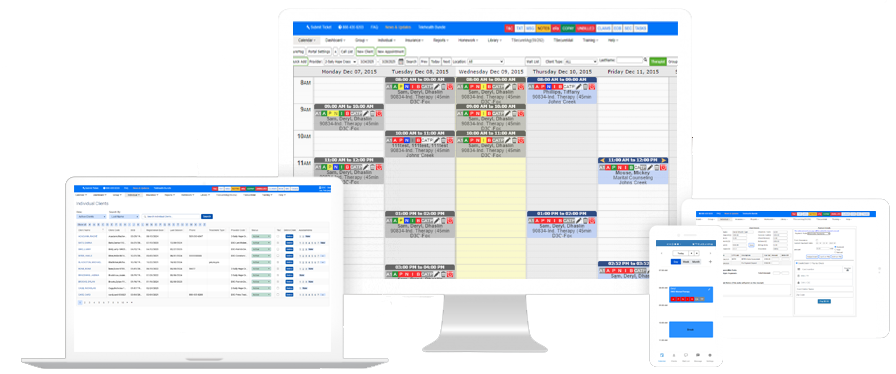
Smart Scheduling
Automated reminders reduce no-shows by up to 30%. The best platforms sync across devices, handle recurring appointments, and manage waitlists without manual work.
AI Clinical Notes
Up to 72% faster note completion (npj Digital Medicine, 2022) in SOAP, DAP, BIRP, and GIRP formats. You review and approve — the software handles the structure.
Insurance Billing & Payments
Streamlined claims processing, electronic remittance (ERAs), and integrated credit card payments — all built in, not bolted on.
HIPAA-Compliant Telehealth
Telehealth use grew 38x post-2020 (McKinsey Health Institute). The best platforms include it natively — not as a separate login or an add-on charge.
Client Portal
Digital intake forms, appointment tracking, secure document sharing, and client messaging — accessible before the first session even happens.
Real Human Support
Not a chatbot. Not a ticket queue. An actual person who picks up the phone, knows what a DAP note is, and can tell you why your ERA reconciliation is off.
Stop buying features piecemeal. See what an all-in-one behavioral health platform actually looks like.
30-day free trial. No credit card required.
Why Human Support Matters More Than You Think
Every software company promises great customer support. Most of them mean a help center, a chatbot, and a ticket queue where you’ll wait two business days for an answer while your billing is frozen.
Think about when things go wrong with your practice management software. It’s rarely a Tuesday afternoon when you have nothing else going on. It’s right before a session. It’s at the end of the billing cycle. It’s when a client’s insurance claim is denied and you don’t know why. That’s when you need a human being who understands behavioral health operations — not a script, not a bot, and not a FAQ article that doesn’t answer your specific question.
This is why 1 in 3 providers switch platforms within two years. They chose the polished interface and the low introductory price. The support experience didn’t match.
The support gap: According to Capterra and G2 reviews, “customer support quality” is the single most cited factor in both satisfaction and dissatisfaction — outranking price, features, and ease of use. It’s the last thing most providers evaluate before buying, and the first thing they regret ignoring.
How the Top Practice Management Software Platforms Compare
We’re not going to pretend we’re neutral here — we’re one of the platforms in the table below. But after 17 years of building specifically for behavioral health, we’ve talked to enough practices who switched from other platforms to recognize the patterns: the platform that looked cheapest usually wasn’t once add-ons were factored in, the one with the best-looking interface often had the weakest billing, and the migration that kept getting postponed always cost more than the subscription savings would have.
The data below is factual. We’d encourage you to verify every cell against each platform’s current pricing page before making a decision. The comparison table matters less than the trial you actually run.

| Feature | Therasoft | SimplePractice | TherapyNotes | Kareo | DrChrono |
|---|---|---|---|---|---|
| Built for Behavioral Health | ✓ Yes | ✓ Yes | ✓ Yes | ✗ General medical | ✗ General medical |
| AI Clinical Notes | ✓ Included | ⚡ Add-on fee | ✗ Manual only | ⚡ Limited add-on | ⚡ Add-on fee |
| Insurance Billing Built-in | ✓ Included | ⚡ Add-on fee | ✓ Included | ✓ Included | ✓ Included |
| HIPAA Telehealth | ✓ Native, included | ✓ Included | ⚡ Limited | ⚡ Add-on | ✓ Included |
| Website Design Services | ✓ Included in suite | ✗ No | ✗ No | ✗ No | ✗ No |
| No Per-Provider Add-on Fees | ✓ Transparent pricing | ✗ Per-provider fees | ✓ Per-provider pricing | ✗ Add-on fees | ✗ Add-on fees |
| Live Human Support | ✓ Phone + email, real staff | ✗ Chat & email only | ✓ Phone available | ✓ Phone available | ✗ Chat & ticket only |
| HIPAA Compliant + BAA | ✓ Standard, included | ✓ Included | ✓ Included | ✓ Included | ✓ Included |
| Group Practice Support | ✓ Solo to group, no switch | ✓ Yes | ✓ Yes | ⚡ Enterprise-focused | ✓ Yes |
Key takeaway: Therasoft is the only platform in this comparison that includes AI clinical notes, native telehealth, website design services, live human support, and transparent all-in-one pricing — without requiring add-ons for core features. No other platform in this list offers all of those without an add-on charge. Built specifically for behavioral health for 17 years.
How to Choose Practice Management Software Without Getting Burned
Most therapists choose their first practice management software the same way: a colleague recommends it, or it comes up first in a search. That works until it doesn’t — usually around the time the first billing cycle produces a denial batch nobody knows how to trace, or a support ticket sits unanswered for three days during credentialing.
The most important test most providers never run: call the support line with a real question before you sign up. Not during a sales demo. Call the general support number on a Tuesday afternoon and see who answers, how long it takes, and whether they understand what you’re actually asking. That single test tells you more than any feature comparison.
The Trial Test Most Therapists Skip
- ✓Call their support line with a real question during business hours. Note wait time and whether you reached a human.
- ✓Complete a full billing cycle: scheduling → notes → claim submission → ERA receipt.
- ✓Run a telehealth session with a test account to confirm HIPAA compliance documentation is in order.
- ✓Build out one complete client file: intake forms, treatment plan, and 3 progress notes.
- ✓Test the mobile app if you see clients across locations or work remotely.
- ✓Ask directly: what does the BAA cover, and where is client data stored?
- ✓Calculate total monthly cost including per-provider fees, billing add-ons, and telehealth charges.
- ✓Check recent Capterra and G2 reviews filtering specifically for support-related feedback.
Switching platforms? Ask about data export options before you commit to anything new. Most platforms allow you to export client records as PDFs or CDA files. Confirm this in writing. Your client data belongs to you.
Frequently Asked Questions: Practice Management Software
Ready to Reclaim Your Time?
Join thousands of therapists who’ve trusted Therasoft for 17 years.
Affordable practice management software built for behavioral health. Backed by real humans.
Sources & Research
- American Psychological Association. (2023). Practitioner Burnout and Administrative Burden Survey. apa.org
- National Council for Mental Wellbeing. (2022). Mental Health Workforce Survey. thenationalcouncil.org
- Tran, B. et al. (2022). AI-assisted clinical documentation in outpatient behavioral health. npj Digital Medicine. pubmed.ncbi.nlm.nih.gov
- Medical Group Management Association. (2023). Healthcare Billing Error Cost Report. mgma.com
- McKinsey Health Institute. (2021). Telehealth: A Quarter-Trillion-Dollar Post-COVID-19 Reality. mckinsey.com
- U.S. Department of Health & Human Services. (2024). HIPAA Security Rule Guidance. hhs.gov
- Centers for Medicare & Medicaid Services. (2023). Electronic Health Records and Claims Processing. cms.gov